Understanding a system built for meat
At 3coty®, we talk about digestion for a simple reason. Food is not an abstract concept for cats. It is a physical event that happens inside a body built for one kind of nutrition. When digestion is supported, the cat is not just fed. The body is allowed to do what it was designed to do, without unnecessary compromise. This understanding is also the foundation of why we exist. Every tin of 3coty® cat food is built around the same principle: respecting how a cat’s body is meant to digest and use food. The feline body is not a simplified version of other mammals, but a highly specialised system where every process is precise, interconnected, and shaped by a unique evolutionary path.
Modern feeding choices often focus on ingredients, percentages, and promises. Digestion sits underneath all of that. It is the difference between food that becomes usable nutrition and food that becomes something the body has to manage. If we want to design cat food responsibly, we have to start here, with the path food is meant to take through a feline digestive system.
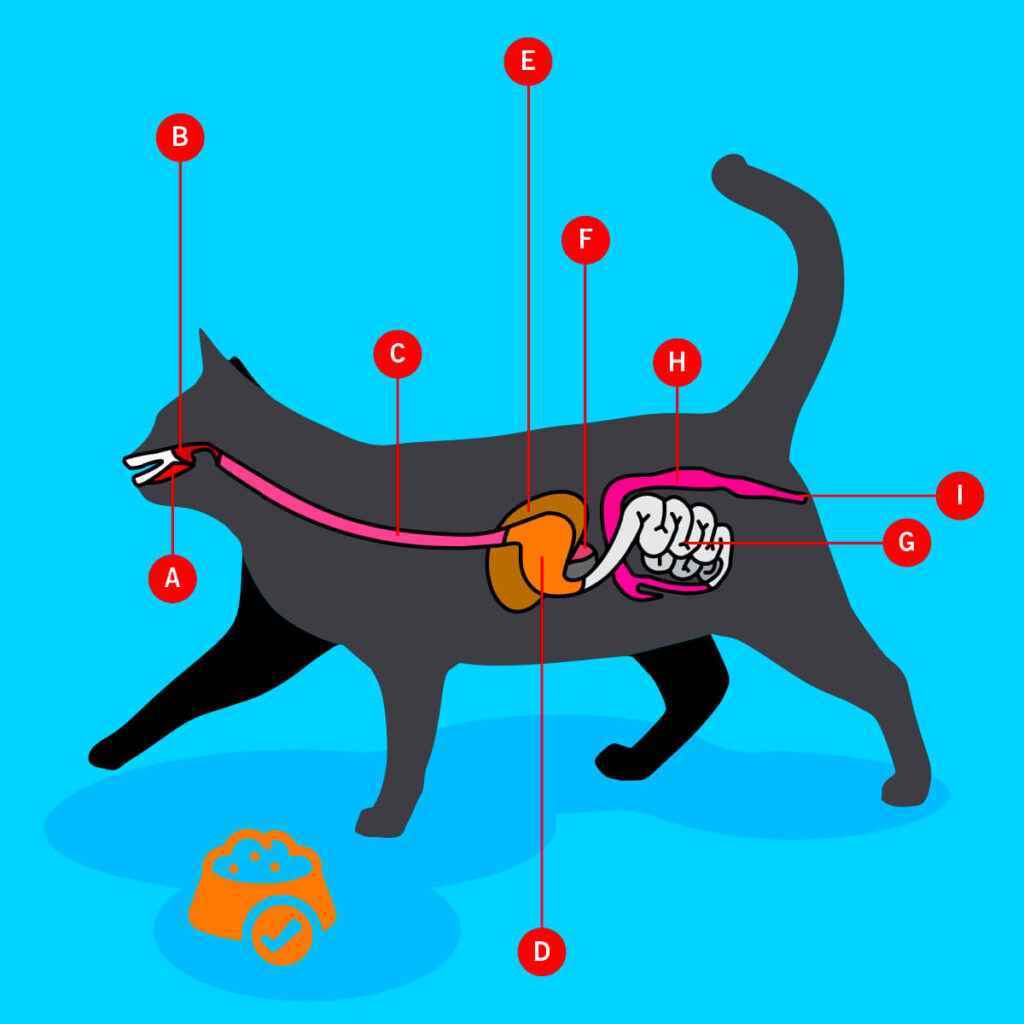
Cat’s digestive system: A: Tongue. B: Pharynx. C: Esophagus. D: Stomach. E: Liver. F: Gallbladder. G: Small intestine. H: Large intestine. I: Anus. The gallbladder is often shown in digestive system illustrations because it stores bile used in fat digestion. Anatomically, it is an accessory organ connected to digestion rather than part of the digestive tract itself.
The science
Digestion is a fundamental biological process that allows animals to convert food into usable nutrients. From the moment food enters the body, a sequence of physical and chemical steps begins, designed to release nutrients, support metabolism, and keep the body in balance. While these principles are universal, the way digestion works in practice depends very much on what a body is designed to eat.
Herbivores, omnivores, and carnivores all digest food, but they do not do so in the same way. Their digestive tracts differ in length, structure, enzyme activity, and reliance on microbial processes. These differences are not minor details. They reflect deep evolutionary adaptations to very different diets and nutritional strategies.
Cats sit at one extreme of this spectrum. As obligate carnivores, their digestive system is streamlined for animal nutrition. It is built for efficiency rather than flexibility, and for precision rather than variety. Unlike humans or dogs, cats do not adapt easily to a wide range of food types. Their bodies expect nutrients to arrive in a specific form and to be processed in a specific way. Cats are among the few predators humans domesticated without changing their fundamental dietary needs.
A cat’s body uses nutrients internally to produce energy, maintain tissue, and support vital functions. That is the core of feline metabolism. Digestion completes that picture at a physical level. It explains how food is transformed into nutrients the body can actually use, and where this transformation is meant to happen.
Understanding feline digestion therefore requires more than general knowledge about how animals digest food. It requires looking closely at where digestion happens in a cat’s body, what each part of the digestive tract is designed to do, and how this system supports a metabolism that depends on animal nutrition.
Where digestion happens in cats
Digestion begins in the mouth, but not with enzymes
In cats, the mouth plays a primarily mechanical role. The feline tongue is adapted for handling meat, with backward-facing papillae shaped like small hooks that help grip and move food efficiently. Chewing is limited compared to omnivores, and food is often swallowed in relatively large pieces rather than being finely ground.
Saliva in cats serves to moisten food and protect the tissues of the mouth. It does not play a meaningful role in breaking food down chemically. Unlike in some other species, feline saliva contains no significant enzymes for digesting carbohydrates. From the very first step, the cat’s digestive system reflects a design that is not intended to process complex plant-based components.
The stomach prepares food for enzymatic digestion
After swallowing, food enters the stomach, where chemical processing begins. The feline stomach is highly acidic, creating an environment that denatures proteins and helps control bacterial load. This acidity is well suited to an animal-based diet and is an essential part of preparing food for the next stage of digestion.
The stomach does not absorb nutrients to any significant extent. Its role is preparatory. Proteins are unfolded, fats begin to separate, and food is converted into a semi-liquid form that can be processed efficiently in the small intestine. The stomach sets the conditions for digestion but does not complete it.
The small intestine is the centre of digestion and absorption
In cats, the small intestine is the most important part of the digestive system. This is where the majority of digestion and nearly all nutrient absorption takes place. Enzymes released from the pancreas break proteins down into amino acids and fats into fatty acids and glycerol, while bile supports the digestion and uptake of fats.
The lining of the small intestine is specialised for absorption. Amino acids, fatty acids, vitamins, and minerals pass through the intestinal wall into the bloodstream, where they are delivered to tissues throughout the body. This process is efficient and tightly regulated, reflecting the cat’s need for a constant and reliable supply of specific nutrients.
When digestion functions as it should, most usable nutrition is absorbed at this stage. Food that aligns with a cat’s biological design allows digestion to be completed here, without placing unnecessary demands on later parts of the digestive tract.
The large intestine has a secondary role
Material that is not absorbed in the small intestine passes into the large intestine. In cats, this part of the digestive tract is relatively short and simple compared to that of omnivores and herbivores. Its main functions are water reabsorption and the formation of stool.
The large intestine also contains bacteria, but in cats their role is limited. The feline digestive system is not built around fermentation as a primary nutritional strategy. Any microbial activity that occurs here is secondary, not central, to meeting the cat’s nutritional needs.
This distinction is important. The large intestine is not designed to handle large amounts of undigested nutrients or complex fermentable material. When excessive material reaches this part of the gut, digestion begins to shift away from its intended path.
Why digestion location matters
Understanding where digestion and absorption happen helps explain why certain foods are better tolerated by cats than others. Nutrients are meant to be broken down and absorbed in the small intestine, not pushed into the large intestine to be managed by bacteria. When digestion is completed upstream, the body can use nutrients efficiently and predictably.
This is not a question of preference or trends. It is a matter of anatomy and physiology. The feline digestive system is streamlined for animal nutrition and works best when food supports that design rather than challenging it.
Digestion can be supported, but it cannot be forced into a better version of itself by complexity. In practice, the most reliable support comes from aligning food with the system cats already have. This is why we keep our recipes meat-only and why any functional additions in dedicated lines are chosen to support the digestive environment rather than to slow, stimulate, or override normal function. Ingredients such as Ascophyllum nodosum are used with this mindset, as supportive components, not as corrections.
Many people assume that probiotics are a universal solution for digestion, because in humans they are often discussed as a sign of gut health. In cats, the logic is different. Cats evolved to digest and absorb most nutrition in the small intestine from animal-based food, with only a limited role for microbes in the large intestine. Probiotics may sometimes be used as a supportive tool during disruption, but they do not change what a cat is designed to eat. The most reliable foundation for digestive stability remains the same: giving cats food that matches the system evolution built.
In some formulations, isolated or technologically derived ingredients are used and described as supporting digestion. While such compounds may influence digestive processes in theory, they are not part of a cat’s natural diet and do not originate from animal tissue. From a biological perspective, supporting digestion does not mean adding substances the system was never built to process, but aligning food with the digestive design cats already have.
Why this matters to us
There is always a reason behind how we formulate our food. At 3coty®, the science of feline digestion sits at the core of every decision we make.
A cat’s digestive tract is designed to complete digestion and absorption in the small intestine, where nutrients belong to the cat’s body. When food respects that design, digestion remains efficient, predictable, and quiet. When food pushes more material downstream, the digestive burden shifts toward the large intestine, where bacteria take on a role they were never meant to play.
Our work begins with a single question: does this ingredient help digestion follow its intended path, or does it create work the cat never needed?