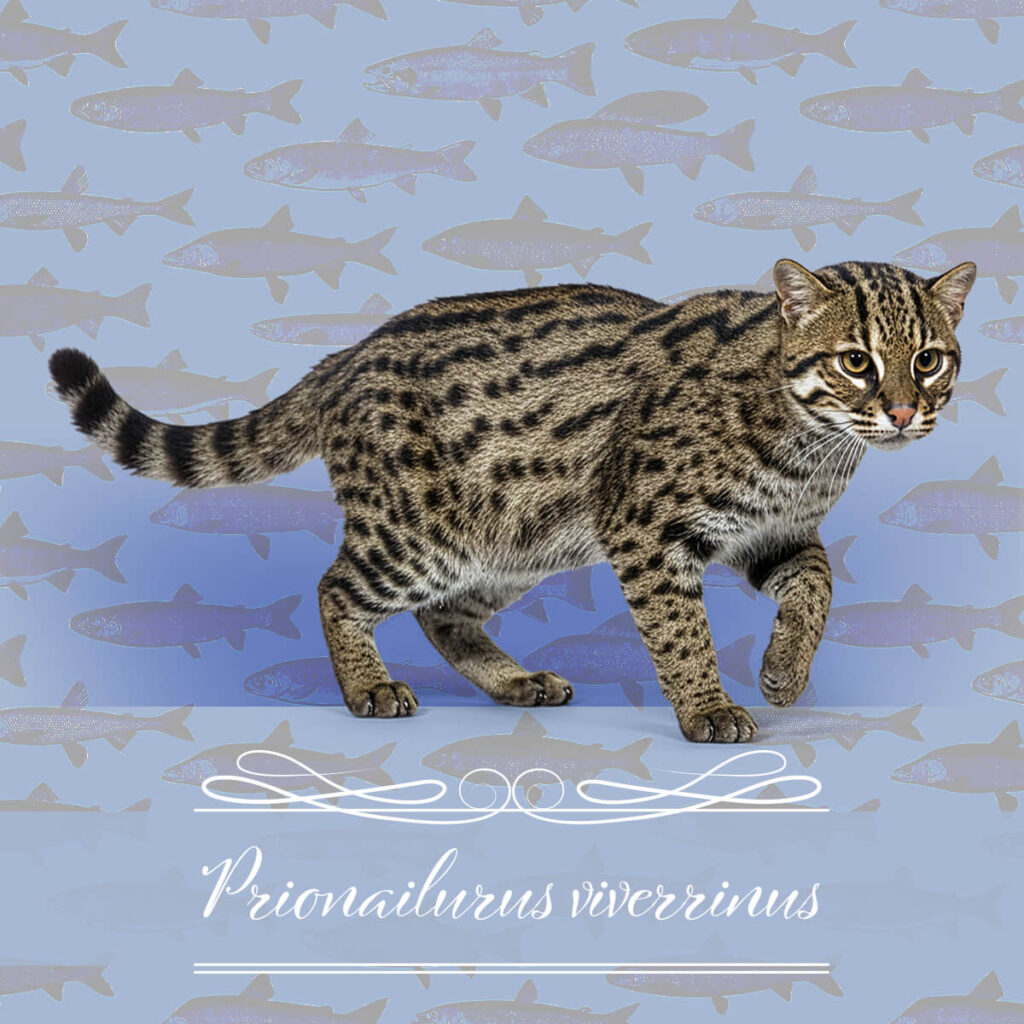
A wild cat that exposes a modern feeding myth
Did you know that February is recognised as the Month of the Fishing Cat by the Fishing Cat Conservation Alliance. The Fishing Cat (Prionailurus viverrinus) is a wild cat native to South and Southeast Asia, where it lives in wetlands, riverbanks, mangroves, and flooded grasslands. It was first scientifically described in 1833 by the French naturalist Georges Cuvier and remains one of the most unusual wild cat species in the world. Because it swims, dives, and hunts in water, it is often used as evidence that cats are natural fish eaters.
There is just one problem. Your cat is not a Fishing Cat.
Biologically, the Fishing Cat is an obligate carnivore, just like the domestic cat, Felis catus. The Fishing Cat evolved from the Asian leopard cat lineage around 5.9 million years ago, while domestic cats evolved later from the Felis lineage around 3.4 million years ago. Their last common ancestor lived approximately 6.2 million years ago. Despite this long separation, their digestive systems, nutrient requirements, and hunting instincts remain fundamentally the same, all built around animal prey. What separates them is not biology, but environment. The Fishing Cat evolved where aquatic prey is abundant, while domestic cats evolved primarily as hunters of birds and small mammals. Same biology. Different opportunity.
The Fishing Cat is also far more powerful than most people realise. Adults weigh between 8 and 16 kilograms, roughly twice the size of a domestic cat. Its short legs, stocky build, and broad head are designed for strength rather than speed. It hunts mostly at night, and there are reports of it killing prey larger than itself, including dogs and calves. This is a serious predator, not a dietary specialist shaped by preference.
Despite its name, fish is only one part of the Fishing Cat’s diet. In the wild, it also eats amphibians, crustaceans, birds, rodents, snakes, and small mammals, and will scavenge when opportunity allows. Fish is eaten because it is available, not because it is essential. Eating fish does not redefine what a cat is.
And this is precisely why the Fishing Cat matters. In modern cat food, fish is often treated as a natural default, a primary protein, or even a healthier option. Looking at wild cats shows how misleading that assumption is. Even a cat that swims and hunts fish remains a meat eater first. Fish can contribute specific nutrients, such as omega fatty acids, but it was never meant to replace meat as the foundation of a cat’s diet. Nature does not support fish based feeding as a norm. It supports meat.
Wild cats eat what is available. Domestic cats eat what you decide.

Did you know?
Built for water
The Fishing Cat’s body is a study in adaptation. A double layered coat keeps its skin dry while swimming. Its claws never fully retract, gripping slippery prey like crampons. The tail is flat and muscular, working as a rudder. And those famous “webbed paws”? Barely webbed at all, just slight skin between the toes.
Hunting technique
The Fishing Cat does not chase fish. It lures them. Sitting at the water’s edge, it taps the surface with its paw, mimicking an insect. When a fish investigates, the cat dives headfirst and grabs it in its jaws. No scooping. No splashing. Pure ambush.
Disappearing world
Fewer than 3,000 Fishing Cats remain in the wild. They once ranged across South and Southeast Asia, including India, Nepal, Bangladesh, Sri Lanka, Thailand, Cambodia, and Java. In Vietnam, they are probably already gone. The cause is not hunters. It is wetlands, drained, developed, disappeared. The fish specialist is running out of water.