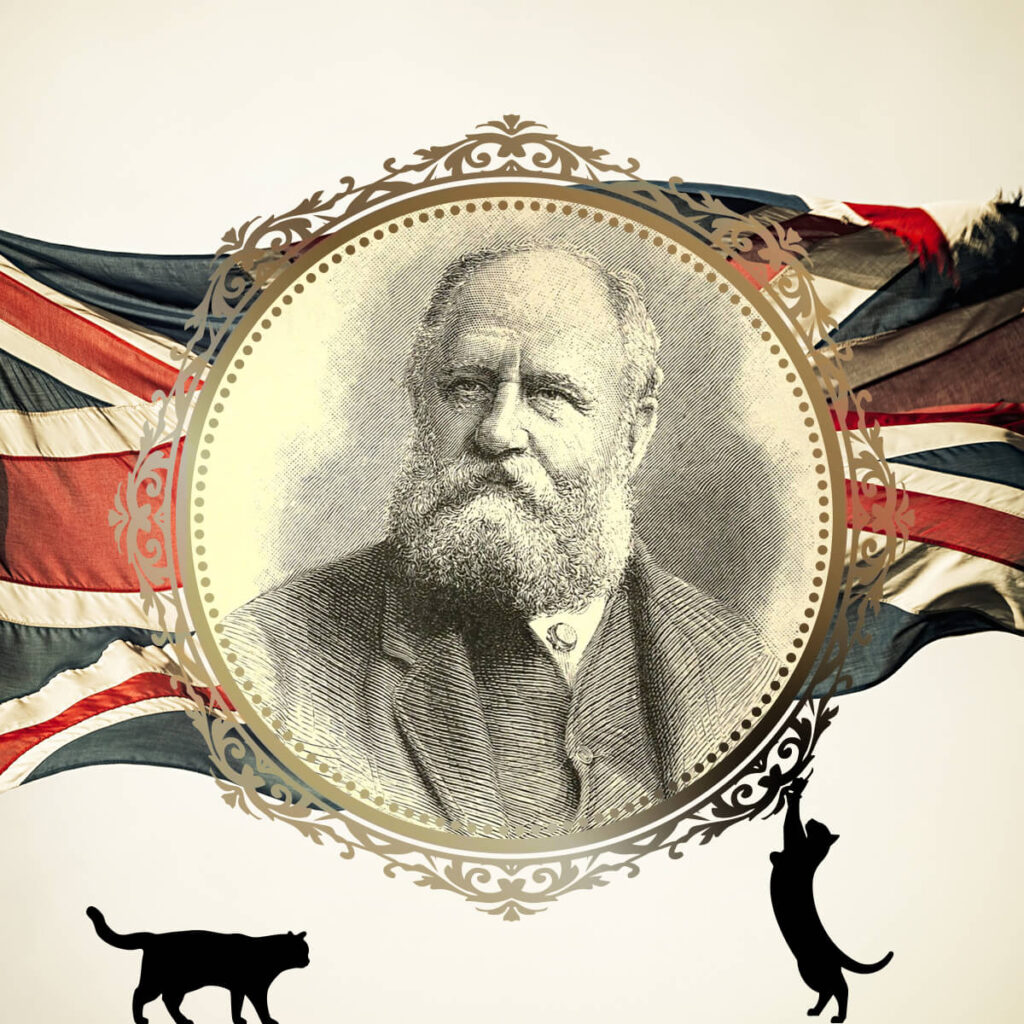
Harrison Weir and the moment everything changed
Not that long ago, cats were not admired in the way we think of today. They lived in kitchens, barns, and alleyways, doing what was expected of them. They kept mice under control, stayed out of the way, and if they found a warm place by the fire, that was already enough. They were useful animals, but they were not seen.
In 1860s England, a cat did not belong in a well-appointed room. Dogs had status, horses had prestige, but cats were practical. Their value was measured in what they did, not in what they were. No one spoke about their form, their individuality, or their presence in any meaningful way.
Harrison Weir did.
As an artist and observer of animals, he spent his life looking closely. Not just at behaviour, but at structure, variation, and detail. He bred cats, studied them, and believed that what most people overlooked was worth attention. Where others saw something ordinary, he saw something unrecognised.
On 13 July 1871, he turned that idea into something real. At Crystal Palace in London, around 170 cats were presented to the public, carefully placed on crimson cushions and shown. Not hidden, not working, but simply there to be looked at.
People came, and more importantly, they stayed. Aristocrats stood next to working-class owners, all looking at the same animals and, for the first time, seeing them differently. Not as background, but as something to observe, compare, and appreciate. The event became a sensation, not because cats had changed, but because people had.
There is a small story from that day that says a lot. On the train to the show, Weir met a friend who dismissed the whole idea. A show of cats made no sense to him, he did not like them, did not understand them, and could not see the point, and yet, he went in anyway, which is often how change happens, not all at once, but through one idea, one conversation, and one person willing to see something differently.
What followed shaped everything that came after. Weir created the first written standards, giving structure to something that had never been clearly defined. He described what to look for, how to compare, and how to recognise variation. He founded the National Cat Club and later wrote the first book dedicated entirely to cats and their characteristics. For the first time, cats were being taken seriously.
In his own words, he wrote that it would be worthwhile to hold cat shows so that the domestic cat sitting by the fire could be seen with a beauty and attractiveness people had not imagined before. That idea still holds. Not because cats have changed, but because our understanding of them continues to evolve.
Harrison Weir was born on 5 May 1824, more than two centuries ago. Every cat show, every breed standard, and every organised way of looking at cats traces back to what he started.
At 3coty®, we often talk about understanding cats as they are, not as we would like them to be. That way of thinking did not appear out of nowhere. It started when someone took the time to look properly and realised that cats were not just part of the background, but something to be understood on their own terms. Sometimes it takes one person, or even one cat, to change everything. For us, it started with one. For Harrison Weir, it was many.
The next time you are at a cat show, or even just hear about one, remember that none of this existed before one person decided that cats were worth looking at properly. One man made it happen.

Did you know?
Weir once wrote, “It would be well to hold Cat Shows, so that the domestic cat sitting in front of the fire would possess a beauty and attractiveness unimagined.” His vision was never about trophies, but about dignity, about recognising the everyday cat as worthy of respect.
The original standards Harrison Weir’s original 1871 standards judged cats on a 100-point scale: 50 points for colour and markings, 15 for head, 10 for size, 10 for shape, 10 for coat quality, and 5 for condition. Health and cleanliness could make or break a winner.
Within 25 years of the Crystal Palace show, cat fancies had formed across Europe and America. The first US cat show was held at Madison Square Garden in 1895. Weir’s simple idea, judge cats fairly, went global.
The most celebrated cat at the 1871 Crystal Palace show was a 14-year-old blue tabby named “The Old Lady.” She won not for pedigree, but for condition and temperament, proving Weir’s point that any well-cared-for cat deserved recognition.
In 1889, Harrison Weir published “Our Cats and All About Them,” the first comprehensive book on cat breeds, care, and standards. It remained the definitive reference for decades.